
Stonehaven MRP shows Scottish Parliamentary election could cause Sir Keir Starmer a headache
 Anand Menon
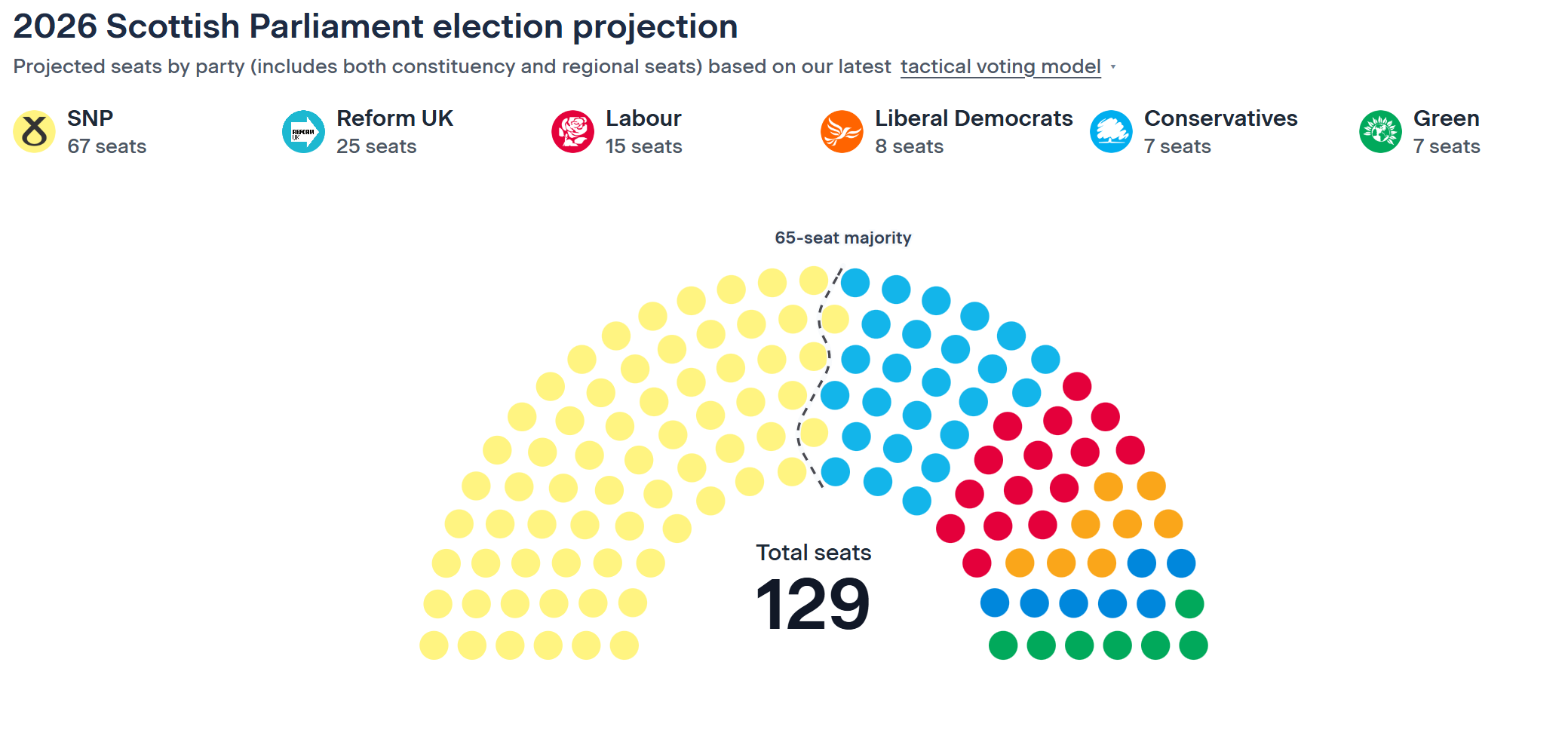
It never rains but it pours. Or so it must feel in Downing St. An historically unpopular Prime Minister. A governing party haemorrhaging support. The arrest of a Labour grandee only recently appointed to a senior diplomatic post. Challenges from the left and the right that threaten to make the local elections a miserable affair. And, to add insult to injury, a new Stonehaven poll forecasts not only that the SNP has a route to a majority in the Scottish Parliament in May’s election, but that Labour might come third to Reform which looks set to become the opposition in Holyrood.
The MRP uses an adjustment to take account of potential tactical voting. And it is this which pushes the SNP over the line, allowing them to triumph over Reform UK in five key constituencies.
The potential implications are seismic. In policy terms, an SNP unencumbered by a coalition partner may adopt not only a different stance on the energy transition and environmental policies but might also pursue a more socially conservative approach to matters relating gender and equality.
But it is the politics that will be really fascinating. On the one hand, an SNP majority Government will be committed to pushing for a second independence referendum (bolstered, on this issue at least, by the presence of seven Green MSPs). Certainly, the Supreme Court affirmed the UK government’s authority to withhold Section 30 consent. Nonetheless, this could quickly become a running sore between the Scottish and UK Governments. A stick with which an SNP Government will choose to beat Keir Starmer to rally support amongst backers of independence.
However, the remarkable progress made by Reform muddies this picture in fascinating ways. The poll forecasts that, whilst Nigel Farage’s party will not win any constituency seats, they will triumph in 25 regional seats (giving them 10 more MSPs overall than Labour). This is a remarkable achievement for a party with only modest infrastructure in place in Scotland and which only named a leader in Scotland in mid-January. Reform’s success has come partly on the back of the increasing salience of immigration as an issue in Scotland, partly as a result of it successfully portraying itself as the anti-incumbent party of ‘change’.
And in keeping with their billing as ‘disruptors’, the party’s success has upset the dynamics of Scottish politics which, since the 2014 referendum, has seen a clear divide between supporters and opponents of independence. The polling reveals that Farage’s party has forced supporters of Labour and the SNP to consider voting for the other party - whatever their differences over independence. 39% of Labour voters would choose the SNP in a straight Reform–SNP contest (only 11% would choose Reform), while 31% of SNP voters would opt for Labour in a straight Labour–Reform contest (only 10% would back Reform).
The plot thickens still given that, remarkably, some 30% of the Reform vote base is supportive of Scottish independence. The implications are mind boggling. Does this mean a Reform-led government in Westminster would be more permissive in its attitude towards a referendum than either of the traditional, unionist, parties of government?
Spare a thought, too, for the Conservatives. They are forecast to lose 24 seats, with under 10% of the vote in both regional and constituency seats, and, with seven seats, tied in last place with the Scottish Greens.
Finally, to return to where we started, a result such as that forecast by this poll will only intensify unrest within the Labour Party (unrest likely to be compounded by poor results in local elections in England and Senedd elections in Wales). The triumph of the SNP has long been factored into expectations. The strong showing by Reform UK however – not merely in terms of seats won, but in finishing second in 54 of the 73 constituency seats – will send a shiver up the spine of even the most phlegmatic Labour MP. It is hard to see how this can have any other impact than to further erode support for Sir Keir Starmer. Not least because Anas Sawar is doubtless going to be ruthless in blaming the national leadership for the Scottish Labour Party’s poor showing.
Now of course this is just one poll. And of course there’s a while before the elections. But the Prime Minister and his team should probably not put their umbrellas away just yet.
Anand Menon is a Director at Stonehaven and Director of UK in a Changing Europe
This is a longer version of an article which appeared the Times' Thunderer column on Wednesday 25 February in Scotland.